
clear

COMPOSITION:
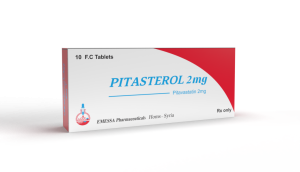
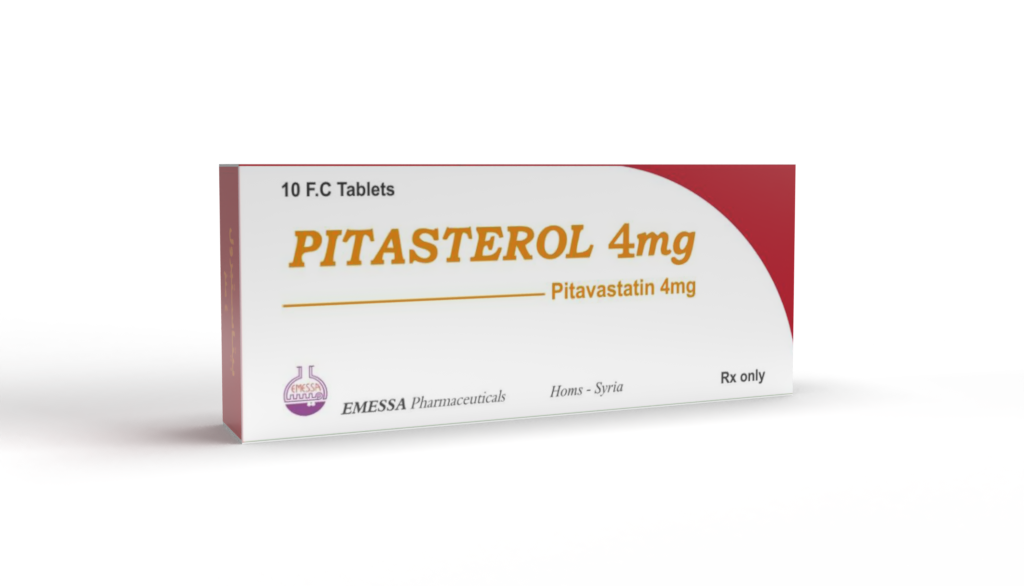
Each PITASTEROL F.Ctd. Tablet contains:
1.045 mg pitavastatin calcium equivalent to 1 mg Pitavastatin.
2.09 mg pitavastatin calcium equivalent to 2 mg Pitavastatin.
4.18 mg pitavastatin calcium equivalent to 4 mg Pitavastatin.
Excipients: Lactose monohydrate, hypromellose, titanium dioxide, magnesium stearate, Aerosil.
MECHANISM OF ACTION:
Pitavastatin competitively inhibits HMG-CoA reductase, so that it inhibits cholesterol synthesis in the liver.
PHARMACOKINETICS:
Absorption:
Pitavastatin peak plasma concentrations are achieved about 1 hour after oral administration.
The absolute bioavailability of is 51%. Administration of PITAVASTATIN CALCIUM with a high fat meal decreases pitavastatin Cmax but does not significantly reduce AUC.
It was absorbed in the small intestine but very little in the colon.
Distribution:
Pitavastatin is more than99% protein bound in plasma, the mean volume of distribution is approximately148 L.
Metabolism:
Pitavastatin is marginally metabolized by CYP2C9 and to a lesser extent by CYP2C8.
Excretion:
Pitavastatin excretes in urine (15%) and feces (79%). The mean plasma elimination half-life is approximately 12 hours.
INDICATIONS:
Primary Hyperlipidemia and Mixed Dyslipidemia:
PITAVASTATIN CALCIUM is indicated as an adjunctive therapy to diet to reduce elevated total cholesterol (TC), low-density lipoprotein cholesterol (LDL-C), apolipoprotein B (Apo B), triglycerides (TG), and to increase HDL-C in adult patients with primary hyperlipidemia or mixed dyslipidemia.
LIMITATION OF USE:
CONTRAINDICATIONS:
The use of PITAVASTATIN CALCIUM is contraindicated in the following conditions:
ADVERSE REACTIONS:
Hypersensitivity reactions including rash, pruritus, and urticaria, Rhabdomyolysis with myoglobinuria and acute renal failure and myopathy (including myositis), Liver Enzyme Abnormalities, elevated creatine phosphokinase, transaminases, alkaline phosphatase, bilirubin, and glucose, Back Pain, Constipation, Diarrhea, Myalgia, Pain in extremity, arthralgia, headache, influenza, and nasopharyngitis.
WARNINGS AND PRECAUTIONS:
Skeletal Muscle Effects:
Cases of myopathy and rhabdomyolysis with acute renal failure secondary to myoglobinuria have been reported with PITAVASTATIN CALCIUM.
Liver Enzyme Abnormalities:
Increases in serum transaminases (AST/SGOT), or (ALT/SGPT) have been reported with PITAVASTATIN CALCIUM.
Endocrine Function:
Increases in HbA1c and fasting serum glucose levels have been reported with HMG-CoA reductase inhibitors, including PITAVASTATIN CALCIUM.
DRUG INTERACTIONS:
Cyclosporine:
Co-administration of cyclosporine with PITAVASTATIN CALCIUM is contraindicated.
Erythromycin:
Erythromycin significantly increased pitavastatin exposure. In patients taking erythromycin, a dose of PITAVASTATIN CALCIUM 1 mg once daily should not be exceeded.
Rifampin:
Rifampin significantly increased pitavastatin exposure. In patients taking rifampin, a dose of PITAVASTATIN CALCIUM 2 mg once daily should not be exceeded.
Gemfibrozil:
Due to an increased risk of myopathy/rhabdomyolysis when HMG-CoA reductase inhibitors are coadministered with gemfibrozil, concomitant administration of PITAVASTATIN CALCIUM with gemfibrozil should be avoided.
Other Fibrates:
PITAVASTATIN CALCIUM should be administered with caution when used concomitantly with other fibrates.
Niacin:
The risk of skeletal muscle effects may be enhanced when PITAVASTATIN CALCIUM is used in combination with niacin; a reduction in PITAVASTATIN CALCIUM dosage should be considered in this setting.
Colchicine:
Cases of myopathy, including rhabdomyolysis, have been reported with HMG-CoA reductase inhibitors coadministered with colchicine, and caution should be exercised when prescribing PITAVASTATIN CALCIUM with colchicine.
Warfarin:
Patients receiving warfarin should have their PT and INR monitored when pitavastatin is added to their therapy.
USE IN SPECIFIC POPULATIONS:
PREGNANCY:
Pregnancy Category X.
PITAVASTATIN CALCIUM is contraindicated in women who are or may become pregnant.
LACTATION:
PITAVASTATIN CALCIUM is contraindicated in Nursing mothers. Women who require this treatment should be advised not to nurse their infants or to discontinue the drug.
PEDIATRIC USE:
Safety and effectiveness of PITAVASTATIN CALCIUM in pediatric patients have not been established.
GERIATRIC USE:
No significant differences in efficacy or safety were observed between elderly patients and younger patients. However, greater sensitivity of some older individuals cannot be ruled out.
RENAL IMPAIRMENT:
Patients with moderate and severe renal impairment as well as end-stage renal disease receiving hemodialysis should receive a starting dose 1 mg once daily and a maximum dose 2 mg once daily.
HEPATIC IMPAIRMENT:
PITAVASTATIN CALCIUM is contraindicated in patients with active liver disease which may include unexplained persistent elevations of hepatic transaminase levels.
DOSAGE AND ADMINISTRATION:
The dose range for PITAVASTATIN CALCIUM is 1 to 4 mg orally once daily at any time of the day with or without food. The recommended starting dose is 2 mg and the maximum dose is 4 mg. The starting dose and maintenance doses of PITAVASTATIN CALCIUM should be individualized according to patient characteristics, such as goal of therapy and response.
After initiation PITAVASTATIN CALCIUM, lipid levels should be analyzed after 4 weeks and the dosage adjusted accordingly.
Dosage in Patients with Renal Impairment
Patients with moderate and severe renal impairment (glomerular filtration rate 30 – 59 mL/min/1.73 m2 and 15 – 29 mL/min/1.73 m2 not receiving hemodialysis, respectively) as well as end-stage renal disease receiving hemodialysis should receive a starting dose 1 mg once daily and a maximum dose 2 mg once daily.
OVERDOSAGE:
There is no known specific treatment in the event of overdose of pitavastatin. In the event of overdose, the patient should be treated symptomatically and supportive measures instituted as required. Hemodialysis is unlikely to be of benefit due to high protein binding ratio of pitavastatin.
Storage conditions:
Store at room temperature between 15°C and 30°C. Protect from light.
Packaging:
A carton box of 20 F.Ctd. tablets for Pitasterol 1 mg.
A carton box of 30 F.Ctd. tablets for Pitasterol 1 mg.
A carton box of 20 F.Ctd. tablets for Pitasterol 2 mg.
A carton box of 30 F.Ctd. tablets for Pitasterol 2 mg.
A carton box of 20 F.Ctd. tablets for Pitasterol 4 mg.
A carton box of 30 F.Ctd. tablets for Pitasterol 4 mg.