
clear

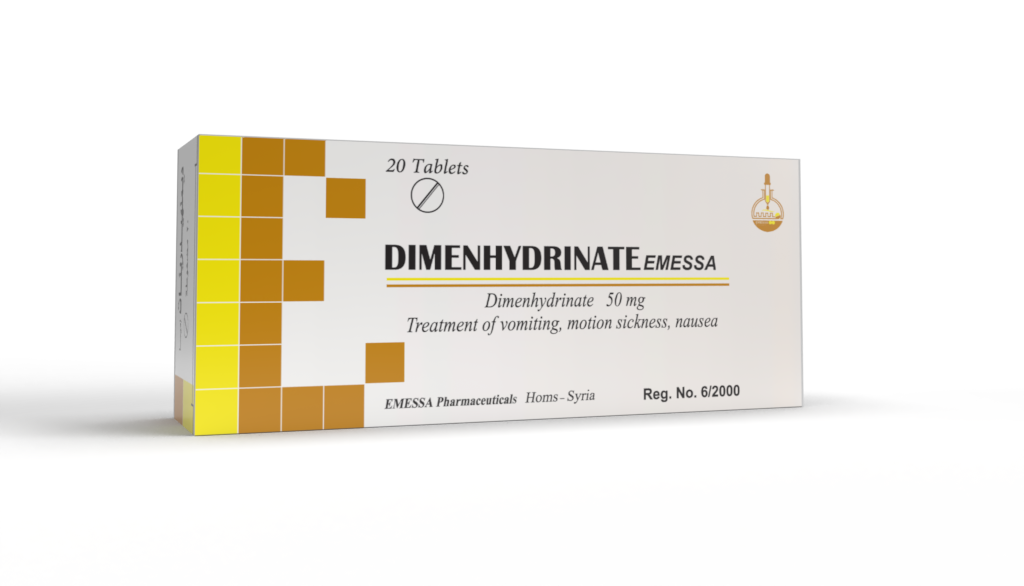
COMPOSITION: Each DIMENHYDRINATE EMESSA tablet contains 50 mg dimenhydrinate.
EXCIPIENTS: Lactose monohydrate, starch, sodium croscarmellose, magnesium stearate.
PHARMACOKINETICS:
Dimenhydrinate is well absorbed from the gastro-intestinal tract after oral dosing with extensive first-pass effect. The drug is metabolised in the liver and excreted usually as metabolites in the urine. The drug is highly bound to plasma proteins and is widely distributed in the body. Following oral administration, the effects develop in about 30 minutes and are maximal within 1-2 hours and last for 3-6 hours.
INDICATIONS AND USAGE:
For prevention and treatment of these symptoms associated with motion sickness:
Dimenhydrinate is used mainly as an anti-emetic in the prevention and treatment of motion sickness; irradiation sickness, postoperative vomiting, drug-induced nausea and vomiting, and the symptomatic treatment of nausea and vertigo due to Meniere’s disease and other labyrinthine disturbances.
CONTRAINDICATIONS:
WARNINS AND PERCAUTIONS:
Should not be used for children under 2 years of age unless directed by a doctor.
Patients should advise a doctor before use if they have:
Patients should advise a doctor before use if they are:
When using DIMENHYDRINATE EMESSA:
Dimenhydrinate should be used with caution in patients with:
PREGNANCY OR BREAST-FEEDING:
Dimenhydrinate should not be used in pregnancy unless the physician considers it is essential.
Dimenhydrinate is excreted in breast milk to such an extent that effects on the suckling child are likely if therapeutic doses of Dimenhydrinate are administered to breast-feeding women.
Effects on ability to drive and use machines:
Patients undergoing treatment with Dimenhydrinate should not take charge of vehicles, other means of transport or machinery where loss of attention may lead to accidents because Dimenhydrinate may cause drowsiness and dulling of mental alertness.
DRUG INTERACTIONS:
Dimenhydrinate will interact with anticholinergic, anti-depressant (tricyclic and MAOIs) and anti-parkinsonian drugs such as Trihexyphenidyl, increasing the anticholinergic side effects, dry mouth, urine retention, confusion, etc.
The effects of Betahistine may be antagonized.
Sedating antihistamines may enhance the sedative effects of CNS depressants including alcohol, other sedating antihistamines, barbiturates, hypnotics, opioids, anxiolytic sedatives and antipsychotics.
It is important that the dose of Neperidine, Morphine or other narcotic analgesics and of barbiturates be reduced by ¼ or ½ when used concomitantly.
ADVERSE REACTIONS:
Adverse effects with Dimenhydrinate may vary in incidence and severity from patient to patient. The most common effect is sedation which may vary from slight drowsiness to deep sleep. The drug may be associated with inability to concentrate, lassitude, dizziness, hypotension, muscular weakness and in co-ordination. When they do occur the sedative effects may diminish after a few days.
DOSAGE AND ADMINISTRATION:
To prevent motion sickness, the first dose should be taken ½ to 1 hour before starting activity to prevent or treat motion sickness:
Adults and children 12 years and over:
1 to 2 tables every 4-6 hours.
For extended relief: take one 100 mg Immediate Release & Long Acting tablet every 8 to 12 hours to a maximum of 3 tablets within 24 hours.
should not take more than 8 tablets in 24 hours, or as directed by a doctor.
Children 6 to under 12 years:
½ to 1 tablet every 6-8 hours.
should not give more than 3 tablets in 24 hours, or as directed by a doctor
Children 2 to under 6 years:
½ tablet every 6-8 hours.
should not give more than 1 ½ tablets in 24 hours, or as directed by a doctor.
Contraindicated for children under 2 years.
Elderly: Same as adult dose.
OVERDOSE:
In the case of severe overdosage, the stomach should be emptied by gastric lavage. Emetics should not be used.
The patient should be kept quiet, particularly in the case of children, to minimise the excitation which occurs. Convulsions may be controlled with Diazepam preferably given intravenously. Since Dimenhydrinate is rapidly metabolised with only traces being in the urine, diuresis is of little, if any, value.
STORAGE CONDITIONS: Store at temperature below 25°c.
PACKAGING: A carton box contains 20 DIMENHYDRINATE EMESSA tablets in 2 blisters.
A carton box contains 100 DIMENHYDRINATE EMESSA tablets in 10 blisters.