
clear

Composition:
Each SILOPRAM F.C tablet contains:
Citalopram hydrobromide corresponding to10mg- 20 mg- 40mg Citalopram.
Pharmacodynamics:
Citalopram is a selective and potent serotonin reuptake inhibitor (SSRI) with antidepressant effect. It has no/very low affinity for a series of receptors including muscarine cholinergic receptors, histamine receptors and adrenoceptors. This absence of effects on the receptors could explain why Citalopram produces less traditional adverse effects than those of the tricyclic antidepressants such as dry mouths, blurred vision, sedation, cardiotoxicity and orthostatic hypotension. Unlike other (SSRls), Citalopram is a very weak inhibitor of the Cytochrome (P450 II D6) metabolic pathway with a consequent reduction in potential for adverse events and interactions.
The antidepressant effect usually sets in after 2 to 4 weeks.
Citalopram does not affect the cardiac conduction system or blood pressure. This is particularly important for elderly patients. In addition, Citalopram does not affect the haematological, hepatic or renal systems. The low frequency of side effects and the minimal sedative properties of Citalopram makes it especially useful in long-term treatment. Moreover, Citalopram neither causes weight gain nor potentiates the effect of alcohol.
Pharmacokinetics:
Biotransformation of Citalopram is mainly hepatic. The oral bioavailability of Citalopram is about 80%. Maximum Citalopram plasma levels are reached in 2 to 4 hours after dosing. The protein binding is below 80%. Metabolism proceeds by demethylation, deamination and oxidation. Unchanged Citalopram is the predominant compound in plasma. The Kinetics is linear. Steady-state conditions are achieved in 1-2 weeks. The biological half-life is about 1 ½ days. Excretion is via urine and faeces.
Indications:
Treatment of depression. The efficacy of Citalopram in the treatment of depression was established in 4 to 6 weeks.
SILOPRAM is administered as a single daily dose, SILOPRAM tablets can be taken any time of the day without regard to food intake.
SILOPRAM is administered as a single oral dose of 20 mg daily. Depending on individual patient response and severity of depression the dose may be increased to a maximum of 60 mg daily.
Elderly (above 65 years):
The recommended daily dose is 20mg.
Depending on individual patient response and severity of depression the does may be increased. Increasing the dose more than 40mg is not recommended, unless in special cases according to the doctor’s instructions.
Not recommended, as safety and efficacy have not been established in children.
Reduced hepatic function:
Dosage should be restricted to the lowest possible daily dose.
Dosage adjustment is not necessary in cases of mild or moderate renal impairment.
No information is available in cases of severe renal impairment
A treatment period of at least 6 months is usually necessary to minimize potential for relapse.
Pregnancy and Lactation:
The safety of SILOPRAM during human pregnancy and lacation has not been established.
SILOPRAM appears in milk of nursing mothers.
Effects on ability to drive or use machines:
SILOPRAM does not impair intellectual function and psychomotor performance. However, patients who are prescribed psychotropic medication should be cautioned about their ability to drive a car and operate machinery.
Adverse effects:
Symptoms:
When SILOPRAM has been taken in large doses recorded symptoms/signs were: somnolence, coma, stiffened expression, episode of grand mal convulsion, sinus tachycardia, occasional nodal rhythm, sweating, nausea, vomiting, cyanosis, hyperventilation. No case was fatal. The clinical picture was inconsistent.
Treatment:
There is no specific antidote. Treatment is symptomatic and supportive. Gastric lavage should be carried out as soon as possible after oral ingestion. Medical surveillance is advisable.
Store at room temperature (below 25o C). Keep out of reach of children.
Packaging:
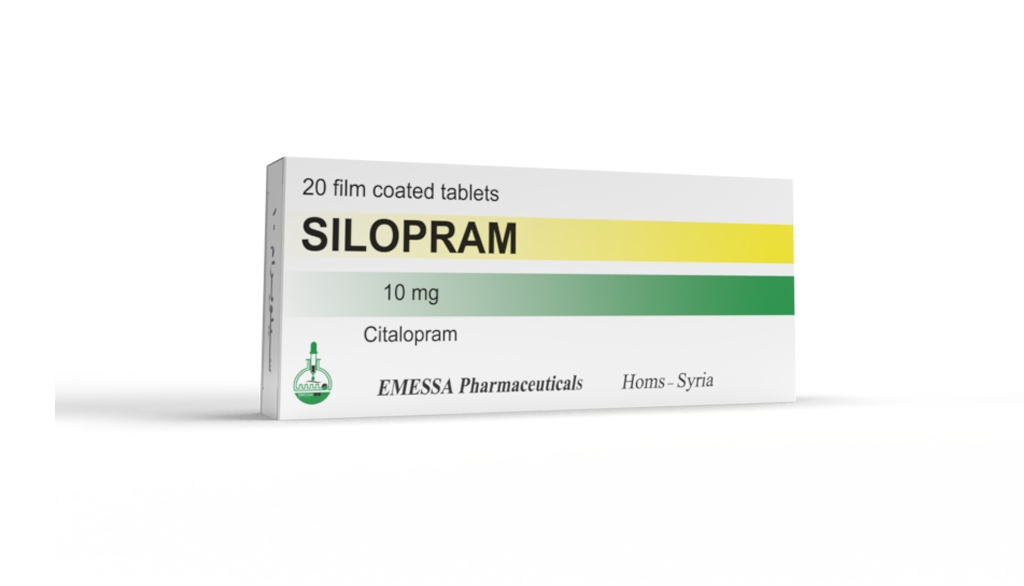
– SILOPRAM 10: A carton box containing 20 F.C SILOPRAM 10 tablets in 2 blisters.
– SILOPRAM 20: A carton box containing 20 F.C SILOPRAM 20 tablets in 2 blisters.
– SILOPRAM 40: A carton box containing 20 F.C SILOPRAM 40 tablets in 2 blisters.