
clear

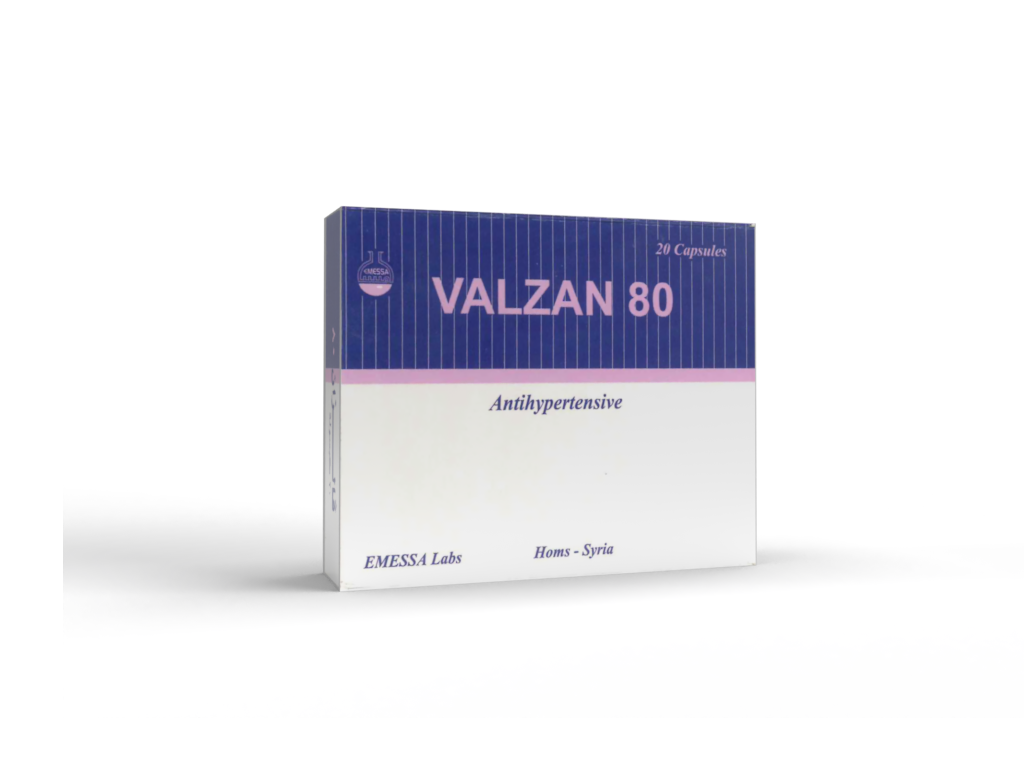
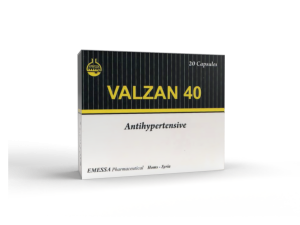
Composition: Each capsule of VALZAN contains 40 mg or 80 mg or 160 mg Valsartan.
| Warning:
FETAL TOXICITY: When pregnancy is detected, discontinue valsartan as soon as possible. Drugs that act directly on the renin-angiotensin system can cause injury and death to the developing fetus. |
Mechanism of action:
Valsartan blocks the vasoconstrictor and aldosterone-secreting effects of angiotensin II by selectively blocking the binding of angiotensin II to the AT1 receptor in many tissues, such as vascular smooth muscle and the adrenal gland.
PHARMACOKINETICS:
Valsartan peak plasma concentration is reached 2 to 4 hours after dosing. Absolute bioavailability for valsartan is about 25%. Valsartan is primarily recovered in feces (about 83% of dose) and urine (about 13% of dose). The average elimination half-life is about 6 hours. Valsartan is highly bound to serum proteins (95%) mainly serum albumin. Valsartan does not accumulate appreciably in plasma following repeated administration.
Indications:
Hypertension: Valsartan may be used alone or in combination with other antihypertensive agents.
Heart Failure: Valsartan is indicated for the treatment of heart failure (NYHA class II-IV). In a controlled clinical trial, Valsartan significantly reduced hospitalizations for heart failure. There is no evidence that Valsartan provides added benefits when it is used with an adequate dose of an ACE inhibitor.
Post-Myocardial Infarction: In clinically stable patients with left ventricular failure or left ventricular dysfunction following myocardial infarction, Valsartan is indicated to reduce cardiovascular mortality.
Contraindications:
Warning and precaution:
Hypotension: The hypotension condition should be corrected prior to administration of valsartan, or the treatment should start under close medical supervision. Caution should be observed when initiating therapy in patients with heart failure or post – myocardial infarction patients. Discontinuation of therapy because of continuing symptomatic hypotension usually is not necessary when dosing instructions are followed. If excessive hypotension occurs, the patient should be placed in the supine position and, if necessary, given an intravenous infusion of normal saline. A transient hypotensive response is not a contraindication to further treatment, which usually can be continued without difficulty once the blood pressure has stabilized.
Impaired renal function: Patients with renal artery stenosis, chronic kidney disease, severe congestive heart failure, or volume depletion may be at particular risk of developing acute renal failure on valsartan.
Monitor renal function periodically in these patients. Consider withholding or discontinuing therapy in patients who develop a clinically significant decrease in renal function on Valsartan.
Hyperkalemia: Some patients with heart failure have developed increases in potassium. These effects are usually minor and transient, and they are more likely to occur in patients with pre-existing renal impairment. Dosage reduction and /or discontinuation of valsartan may be required.
Pregnancy, Category D:
When pregnancy is detected, discontinue valsartan as soon as possible.
Lactation:
It is not known whether Valsartan is excreted in human milk. Because many drugs are excreted into human milk and because of the potential for adverse reactions in nursing infants from Valsartan, A decision should be made whether to discontinue nursing or discontinue the drug, taking into account the importance of the drug to the mother.
Pediatric use:
In children and adolescents with hypertension where underlying renal abnormalities may be more common, renal function and serum potassium should be closely monitored. Valsartan is not recommended for pediatric patients under 6 years of age.
Drugs interaction:
Transporters: Co-administration of inhibitors of the uptake transporter (rifampin, cyclosporine) or efflux transporter (ritonavir) may increase the systemic exposure to valsartan.
Potassium: Concomitant use of valsartan with other agents that block the renin-angiotensin system, potassium –sparing diuretics (eg, spironolactone, triamterene, amiloride), Potassium supplement, salt substitutes containing potassium or other drugs that may increase potassium levels (e.g, heparin) may lead to increases in serum potassium, and in heart failure patients, increases in serum creatinine.
Non-steroidal anti-inflammatory Agents (including selective Cox 2 – inhibitors): In patients who are elderly, volume – depleted (including those on diuretic therapy) or with compromised renal function, co-administration of NSAID including selective cox-2 inhibitors with angiotensin II receptor antagonists including valsartan may result in deterioration of renal function including possible acute renal failure. The antihypertensive effect of angiotensin II receptor antagonist including valsartan may be attenuated by NSAIDS including selective COX-2 inhibitors.
Dual inhibition of the renin-angiotensin system: Dual blockade of the RAS with angiotensin receptor blockers, ACE inhibitors, or aliskiren is associated with increased risks of hypotension, hyperkalemia, and changes in renal function (including acute renal failure) compared to monotherapy.
Lithium: Increases in serum lithium concentrations and lithium toxicity have been reported during concomitant administration of lithium with angiotensin II receptor antagonists, including valsartan. Monitor serum lithium levels during concomitant use.
Adverse reactions:
For Hypertension in Adult patient: The most common reasons for discontinuation of therapy with Valsaratn were headache and dizziness.
Headache, dizziness, upper respiratory infection, cough, diarrhea, rhinitis, sinusitis, nausea, pharyngitis, edema, and arthralgia occurred at a more than 1%.
For Hypertension in Pediatric patient: Headache and hyperkalemia were the most common adverse events in children (6 to 17 years old) and children (6 months to 5 years old), respectively. Hyperkalemia was mainly observed in children with underlying renal disease.
For patient with Heart Failure: At combination therapy: Dizziness, Hypotension, Diarrhea, Arthralgia, Fatigue, Back Pain, postural Dizziness, Hyperkalemia, postural Hypotension.
Other adverse reactions with an incidence greater than 1%: Headache, nausea, renal impairment, syncope, blurred vision, upper abdominal pain and vertigo.
Post-Myocardial Infarction: Discontinuations due to renal dysfunction occurred in 1.1% of valsartan-treated patients.
Dosage and administration:
Valsartan may be administered with other antihypertensive agents. Valsartan may be administered with or without food.
Adult Hypertension: The recommended starting dose of Valsartan is 80 mg or 160 mg once daily when used as monotherapy in patients who are not volume-depleted. Patients requiring greater reductions may be started at the higher dose. Valsartan may be used over a dose range of 80 mg to 320 mg daily, administered once a day.
The antihypertensive effect is substantially present within 2 weeks and maximal reduction is generally attained after 4 weeks. If additional antihypertensive effect is required over the starting dose range, the dose may be increased to a maximum of 320 mg or a diuretic may be added. Addition of a diuretic has a greater effect than dose increases beyond 80 mg.
No initial dosage adjustment is required for elderly patients, for patients with mild or moderate renal impairment or for patients with mild or moderate liver insufficiency. Care should be exercised with dosing of valsartan in patients with hepatic or severe renal impairment.
Pediatric Hypertension 6 to 16 Years of Age: The usual recommended starting dose is 1.3 mg/kg once daily (up to 40 mg total). The dosage should be adjusted according to blood pressure response. Doses higher than 2.7 mg/kg (up to 160 mg) once daily have not been studied in pediatric patients 6 to 16 years old. Valsartan is not recommended for patients <6 years old
Heart Failure: The recommended starting dose of Valsartan is 40 mg twice daily. Up titration to 80 mg and 160 mg twice daily should be done to the highest dose, as tolerated by the patient. Consideration should be given to reducing the dose of concomitant diuretics. The maximum daily dose administered in clinical trials is 320 mg in divided doses.
Post-Myocardial Infarction: Valsartan may be initiated as early as 12 hours after a myocardial infarction. The recommended starting dose of valsartan is 20 mg twice daily. Patients may be up titrated within 7 days to 40 mg twice daily, with subsequent titrations to a target maintenance dose of 160 mg twice daily, as tolerated by the patient. If symptomatic hypotension or renal dysfunction occurs, consideration should be given to a dosage reduction. Valsartan may be given with other standard post-myocardial infarction treatment, including thrombolytics, aspirin, beta-blockers, and statins.
Over-dosage:
The most likely manifestations of over-dosage would be hypotension and tachycardia; bradycardia could occur from parasympathetic (vagal) stimulation. If symptomatic hypotension should occur, supportive treatment should be instituted. Valsartan is not removed from the plasma by hemodialysis.
Storage conditions: Store at temperature below 25°c, away from moisture.
Packaging: Carton box contains 20 VALZAN capsules of each.