
clear

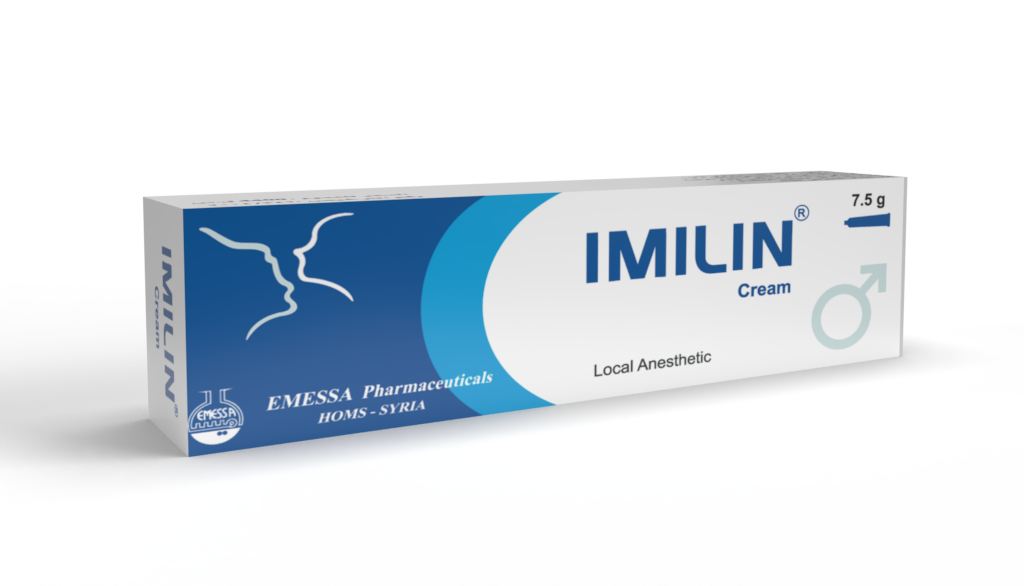
COMPOSITION: Each 1g IMILIN cream contains:
Lidocaine 25 mg
Prilocaine 25 mg
Pharmacodynamic properties:
Lidocaine and prilocaine are amide-type local anesthetic agents. Both lidocaine and prilocaine stabilize neuronal membranes by inhibiting the ionic fluxes required for the initiation and conduction of impulses, thereby effecting local anesthetic action.
Pharmacokinetic properties:
Absorption: The amount of lidocaine and prilocaine systemically absorbed from cream is directly related to both the duration of application and to the area over which it is applied.
Maximum recommended duration of exposure is 4 hours.
In a pharmacokinetic study, IMILIN cream, applied to penile skin in 20 adult male patients in doses ranging from 0.5 g to 3.3 g for 15 minutes. Plasma concentrations of lidocaine and prilocaine were consistently low (2.5 to 16 ng/mL for lidocaine and 2.5 to 7 ng/mL for prilocaine). The application of IMILIN cream, to broken or inflamed skin, or to 2,000 cm2 or more of skin where more of both anesthetics are absorbed, could result in higher plasma levels that could produce a systemic pharmacologic response.
Distribution: lidocaine is approximately 70% bound to plasma proteins, primarily alpha-1-acid glycoprotein. At much higher plasma concentrations (1 to 4 mcg/mL of free base) the plasma protein binding of lidocaine is concentration dependent. Prilocaine is 55% bound to plasma proteins. Both lidocaine and prilocaine cross the placental and blood brain barrier, presumably by passive diffusion.
Metabolism: Lidocaine is metabolized rapidly by the liver to a number of metabolites including monoethylglycinexylidide (MEGX) and glycinexylidide (GX), both of which have pharmacologic activity similar to, but less potent than that of lidocaine.
Prilocaine is metabolized in both the liver and kidneys by amidases to various metabolites including ortho-toluidine and N-n-propylalanine. It is not metabolized by plasma esterases.
In addition, ortho-toluidine can produce methemoglobinemia following systemic doses of prilocaine approximating 8 mg/kg
Very young patients, patients with glucose-6-phosphate dehydrogenase deficiencies and patients taking oxidizing drugs such as antimalarials and sulfonamides are more susceptible to methemoglobinemia.
Elimination: More than 98% of an absorbed dose of lidocaine can be recovered in the urine as metabolites or parent drug. The systemic clearance is 10 to 20 mL/min/kg.
The elimination half-life of prilocaine is approximately 10 to 150 minutes The systemic clearance is 18 to 64 mL/min/kg.
Therapeutic indications:
IMILIN cream is indicated as a topical anesthetic for use on:
Physician may prescribe IMILIN cream to apply on genital mucous membranes to improve Premature Ejaculation disorders, it may reduce penile sensitivity and delay ejaculation.
Contraindications:
patients with a known history of sensitivity to local anesthetics of the amide type or to any other component of the product.
Warning & precautions:
– Application of IMILIN cream to larger areas or for longer times than those recommended could result in sufficient absorption of lidocaine and prilocaine resulting in serious adverse effects).
– Patients treated with class III anti-arrhythmic drugs (e.g., amiodarone, bretylium, sotalol, dofetilide) should be under close surveillance and ECG monitoring considered, because cardiac effects may be additive.
– IMILIN cream should not be used in any clinical situation when its penetration or migration beyond the tympanic membrane into the middle ear is possible.
Methemoglobinemia: Cases of methemoglobinemia have been reported in association with local anesthetic use. Although all patients are at risk for methemoglobinemia, patients with glucose- 6-phosphate dehydrogenase deficiency, congenital or idiopathic methemoglobinemia, cardiac or pulmonary compromise, infants under 6 months of age, and concurrent exposure to oxidizing agents or their metabolites are more susceptible to developing clinical manifestations of the condition. If local anesthetics must be used in these patients, close monitoring for symptoms and signs of methemoglobinemia is recommended.
General: IMILIN cream should be used with caution in patients who may be more sensitive to the systemic effects of lidocaine and prilocaine including acutely ill, debilitated, or elderly patients.
IMILIN cream should not be applied to open wounds.
Information for Patients:
When using IMILIN cream, the patient should be aware that the production of dermal analgesia may be accompanied by the block of all sensations in the treated skin. For this reason, the patient should avoid inadvertent trauma to the treated area by scratching, rubbing, or exposure to extreme hot or cold temperatures until complete sensation has returned.
SIDE EFFECTS:
Localized Reactions: During or immediately after treatment with lidocaine and prilocaine cream, on intact skin, the skin at the site of treatment may develop erythema or edema or may be the locus of abnormal sensation.
Allergic Reactions: Allergic and anaphylactoid reactions associated cream can occur. They are characterized by urticaria, angioedema, bronchospasm, and shock.
IMILIN cream should be used with caution in patients receiving Class I antiarrhythmic drugs (such as tocainide and mexiletine) since the toxic effects are additive and potentially synergistic.
Patients who are administered local anesthetics are at increased risk of developing methemoglobinemia when concurrently exposed to the following drugs, which could include other local anesthetics:
Examples of Drugs Associated with Methemoglobinemia:
Specific interaction studies with lidocaine/prilocaine and class III anti-arrhythmic drugs (e.g., amiodarone, bretylium, sotalol, dofetilide) have not been performed, but caution is advised.
Pregnancy and breast-feeding
Pregnancy: There are no adequate and well-controlled studies in pregnant women. So it should be used during pregnancy only if clearly needed.
Nursing Mothers: Lidocaine, and probably prilocaine, are excreted in human milk. Therefore, caution should be exercised when lidocaine and prilocaine cream, is administered to a nursing mother since the milk: plasma ratio of lidocaine is 0.4 and is not determined for prilocaine.
Pediatric Use:
Studies of lidocaine and prilocaine cream in children under the age of seven years have shown less overall benefit than in older children or adults.
Adult Patients: A thick layer of IMILIN cream is applied to intact skin and covered with an occlusive dressing.
Major Dermal Procedures:
For more painful dermatological procedures involving a larger skin area such as split thickness skin graft harvesting, apply 2 grams of IMILIN cream per 10 cm² of skin and allow to remain in contact with the skin for at least 2 hours.
Adult Male Genital Skin:
As an adjunct prior to local anesthetic infiltration, apply a thick layer of lidocaine and prilocaine cream, (1 g/10 cm2) to the skin surface for 15 minutes. Local anesthetic infiltration should be performed immediately after removal of lidocaine and prilocaine cream.
Dermal analgesia can be expected to increase for up to 3 hours under occlusive dressing and persist for 1 to 2 hours after removal of the cream.
For premature ejaculation: Apply about 2.5 g of cream and allow to remain in contact with the skin for about 15-20 min before sexual contact and then washed off.
Adult Female Patients-Genital Mucous Membranes
For minor procedures on the female external genitalia, as well as for use as pretreatment for anesthetic infiltration, apply a thick layer (5 to 10 grams) of IMILIN cream for 5 to 10 minutes.
Occlusion is not necessary for absorption, but may be helpful to keep the cream in place. Patients should be lying down during the IMILIN cream application, especially if no occlusion is used. The procedure or the local anesthetic kinfiltration should be performed immediately after the removal of IMILIN cream.
The following are the maximum recommended doses, application areas and application times for IMILIN cream based on a child’s age and weight:
| Age and Body Weight Requirements | Maximum Total Dose of Lidocaine and Prilocaine Cream, |
Maximum Application Area |
Maximum Application Time |
| 0 up to 3 months or < 5 kg | 1g | 10 cm² | 1 hour |
| 3 up to 12 months and >5 kg | 2g | 20 cm² | 4 hours |
| 1 to 6 years and >10 kg | 10g | 100 cm² | 4 hours |
| 7 to 12 years and >20 kg | 20g | 200 cm² | 4 hours |
IMILIN cream should not be used in neonates with a gestational age less than 37 weeks nor in infants under the age of 12 months who are receiving treatment with methemoglobin-inducing agents.
Overdose:
Toxic levels of lidocaine (>5 mcg/mL) and/or prilocaine (>6 mcg/mL) cause decreases in cardiac output, total peripheral resistance and mean arterial pressure.
Storage Conditions: Keep it in a cool dry place where the temperature stays below 30°C. Do not let it freeze.
Keep it where young children cannot reach it.
Packaging: Tubes of 7.5g or 30g.